
Units:
cm=centimeter, cfs=cubic foot per second, cms=cubic meter per second, ft=foot, gal=gallon (U.S.), m=meter, min=minute, s=second, yr=year
Drawings and Equation
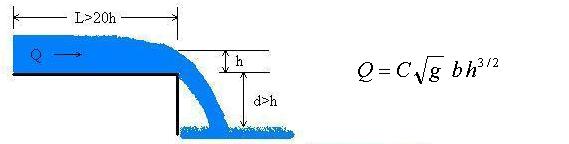
Introduction to Rectangular End Depth Method for Waterfalls
The end-depth method for determining discharge is very useful since channels are easily
constructed to have a free overfall, and natural channels (waterfalls in rivers and streams) often have this configuration.
Due to the minimal installation costs (if any), flow rate measurement using the end depth method is much less
expensive than installing a weir or flume. The equation shown above
for determining discharge in a waterfall in a rectangular open channel is from the International Organization of Standards publication
3847 dated 1977 (ISO, 1977). For the equation to give an
accurate discharge measurement, there are several criteria that should be met:
• Clear water.
• Rectangular channel for a distance at least 20h upstream of the drop-off (aka.
overflow or overfall).
• Channel should be horizontal although a slight slope is okay.
• Channel should be smooth such as would be provided by a neat cement finish.
• Flow should be sub-critical upstream of the drop-off.
• The drop, d, should be greater than h.
• The channel width, b, should be greater than 0.3 m (11.8 inch).
• The end depth, h, should be greater than 0.04 m (1.6 inch).
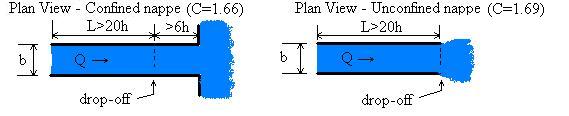
• For a confined nappe, the channel should be rectangular for a distance of greater than
6h downstream of the drop-off, and the nappe should be ventilated so that the
water does not cling to the drop off.
If the criteria are met and h is measured carefully, the accuracy of the discharge measurement is 2% for a horizontal channel and up to 7% for a slightly sloping channel (ISO, 1977).
Variables for Rectangular End Depth Waterfall Equation
[L] indicates length units. [T] indicates time units.
b = Channel width [L]. Must be greater than 0.3 m (11.8 inch) for the
equation to be reliable.
C = Coefficient of discharge. C=1.66 for confined nappe. C=1.69
for unconfined nappe.
d = Drop elevation [L]. Elevation difference between bottom of channel and
tail water. Must be at least h for the equation to be reliable.
g = Acceleration due to gravity=9.8066 m/s2.
h = Measured water depth at end of channel (i.e. at the drop-off) [L]. Must
be greater than 0.04 m (1.6 inch) for the equation to be reliable.
L = Straight length upstream of drop-off [L]. Must be at least 20h
for the flow to be well-established.
Q = Discharge [L3/T]. Also known as flowrate.
Error Messages
"h and b must be >0." Check your input. h or b
was entered as 0.0 or negative.
"Q and b must be >0." Check your input. Q or b
was entered as 0.0 or negative.
"Q and h must be >0." Check your input. Q or h
was entered as 0.0 or negative
"Need b>0.3 m for accuracy." b (channel width) was
entered or computed as ≤ 0.3 m. The calculation finished, but the equation is not
accurate for such a narrow channel.
"Need h>0.04 m for accuracy." h was entered or
computed as ≤ 0.04 m. The calculation finished, but the equation is not accurate
for such a small depth.
References
International Organization of Standards (ISO 3847). 1977. Liquid flow
measurement in open channels by weirs and flumes - End depth method for estimation of flow
in rectangular channels with a free overfall. Reference number: ISO 3847-1977(E).
© 2000-2026 LMNO Engineering, Research, and Software, Ltd. All rights reserved.
LMNO Engineering, Research, and Software, Ltd.
7860 Angel Ridge Rd. Athens, Ohio 45701 USA Phone: (740) 707-2614
LMNO@LMNOeng.com
https://www.LMNOeng.com